The History of the St. Rochusfriedhof (St Roch’s Cemetery)

The St. Rochusfriedhof is located in the city district of Gostenhof on Rothenburger Straße and, together with the St. Johannisfriedhof, is managed by the Lutheran cemetery administration. With its unique combination of historic sandstone ashlars in the prescribed size of three by six “Werkschuh” (Nuremberg foot) with the metal name plaques, the so-called epitaphs, it presents Nuremberg city history as in a picture book. The artisan professions typical for the residents of the Lorenz part of the town are represented in numerous epitaphs with their tools and craft signs. Thus the epitaphs have eternalised over 90 professions here. Those laid to rest in this cemetery not only include craftsmen such as Peter Vischer, the brass and bronze caster, but also the composer Johann Pachelbel and the “Nuremberg hangman”, Franz Schmidt.   
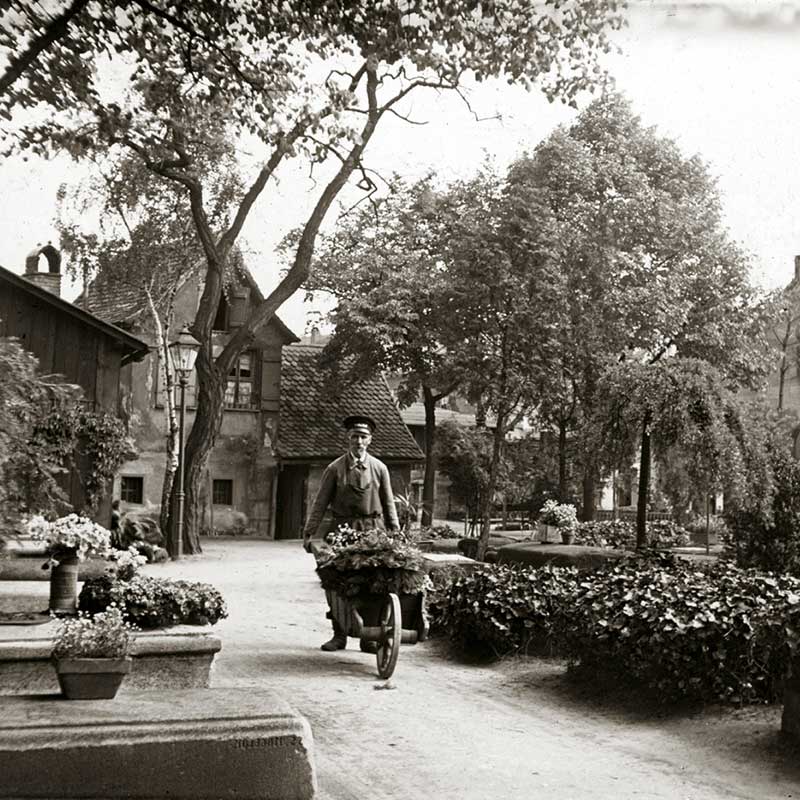
historisches Foto des Rochus Friedhofs

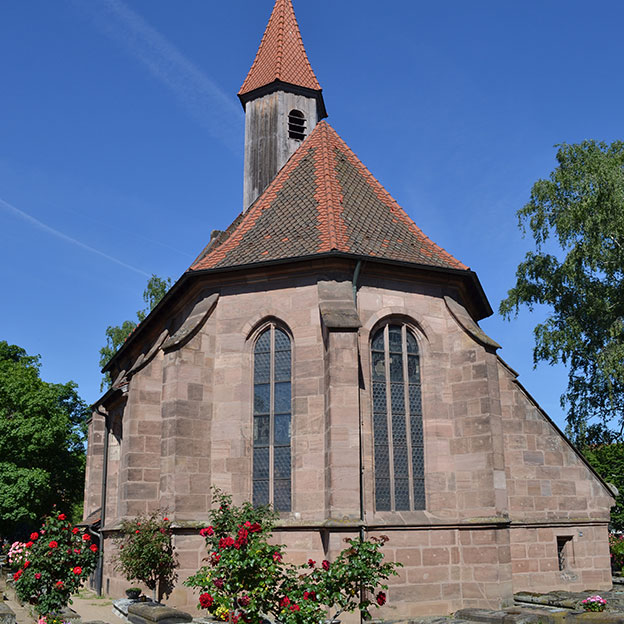
In the middle ages, Nuremberg cemeteries, as was usual at that time, were located around the major churches within the city walls. Due to several waves of the plague, hygienic conditions in these cemeteries had become unacceptable. This is why on 1 October 1518, a decree by Emperor Maximilian I stipulated that people could only be buried outside the town walls. While the Sebald part of the town could resort to the existing lepers’ cemetery in the village of St Johannis, a new cemetery had to be established for the Lorenz part of the town. Close to the Spittlertor (Spital Gate), a plot of land was enclosed with a wall in 1518 and consecrated as a cemetery a year later. The family of Patrician Konrad Imhoff (1463-1519) donated funds for a chapel constructed by master builder Paul Beheim. After a short construction period, the chapel was consecrated in 1521, to St Roch of Montpellier, who was only venerated as a saint in popular tradition. In the early 16th century, the veneration of St Roch of Montpellier was very popular in Italy and was brought to Germany across the Alps via the Imhoff family’s trade connections.

The cemetery was extended three times, and has been preserved in its present shape since 1589/99. In the Second World War, the western side of the chapel suffered extensive damage, and the “Hofmeisterhaus” (house master’s house) which housed the cemetery’s administration as well as the “Totengräberhaus” (gravediggers’ house) were completely destroyed by bombs. The funeral hall of 1843 also fell victim to bombs and could only be reconstructed in 1954. Burials still take place at the cemetery today.

Rochuskapelle Nürnberg

St Roch’s Chapel

The vaulted structure built from sandstone blocks has a 5/8 choir, an adjoining sacristy on the northern side and a one-nave main building. The main altar dates from 1521 and features a figured shrine (Roch, Sebastian and St Martin) in early Renaissance style. The altar wings depict scenes from the life of Saint Roch, painted by Wolf Traut (1486-1520) and his school. In addition, there is a northern side altar, St Catherine’s altar of 1622, by an unknown artist, and a southern side altar, the Rosary altar of 1522, an early Renaissance work with paintings by Hans Burgkmair and wood carvings by Sebastian Loscher. The glass paintings by Veit Hirsvogel the Elder (1461- 1526) are a further ornament of this chapel, complementing the paintings and epitaphs.

Layout

Military Cemetery

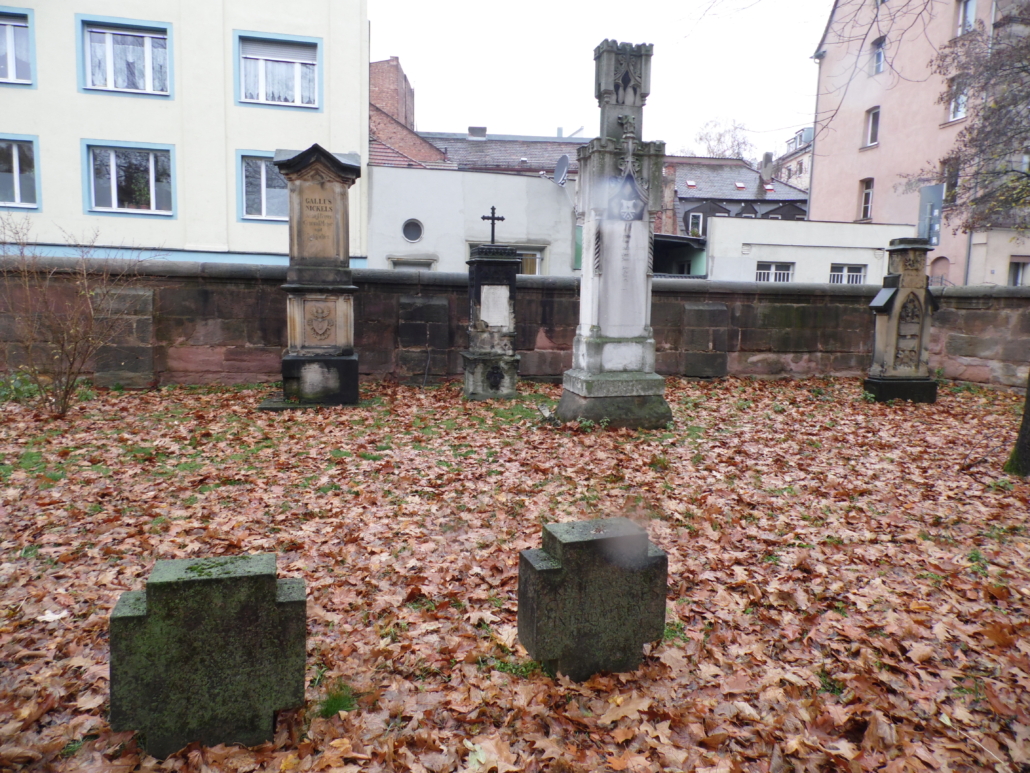
Adjacent to St Roch’s Cemetery in the west, there is a military cemetery, a relic of the times when Nuremberg was a garrison town.

It dates back to a donation by the Nuremberg town lieutenant and red beer brewer Lorenz Schmiedlein. In May 1693, the imperial city’s war office, in keeping with the donor’s intentions, purchased the elongated triangular plot of land between St Roch’s Cemetery and the fortification walls from the Thirty Years’ War (today’s Imhoffstraße), and the soldiers’ cemetery was consecrated in the autumn of the same year. The social background was that badly paid soldiers and their families were to be given a possibility of inexpensive burials. Even after Nuremberg had become part of Bavaria in 1806, this cemetery remained as a social institution. No fees had to be paid for the graves, apart from the customary local payments for military gravediggers. The cemetery had a capacity of 550 graves occupied for a period of 10 years, the so-called “Umtriebszeit” (turnover period). During the First World War, the small cemetery was no longer sufficient for the large number of fallen soldiers, and so a new burial ground for soldiers was established at the South Cemetery. The last burials took place here in 1918. After the Bavarian Army was dissolved in 1919, the old military cemetery was closed down. On 4 March 1924, the City of Nuremberg purchased the grounds with all rights and obligations.

Friedhöfe St. Johannis und St. Rochus