
Famous Deceased

The St. Roch’s Cemetery tells the story of Nuremberg’s history over five centuries.

Originally serving the Lorenz district and later the entire city, St. Roch’s Cemetery is the resting place of many famous — and sometimes now forgotten — citizens and their families.

From Behaim to Pachelbel to Vischer, the graves reflect the rich social and artistic life of Nuremberg.

Berühmte Verstorbene Rochus Friedhof

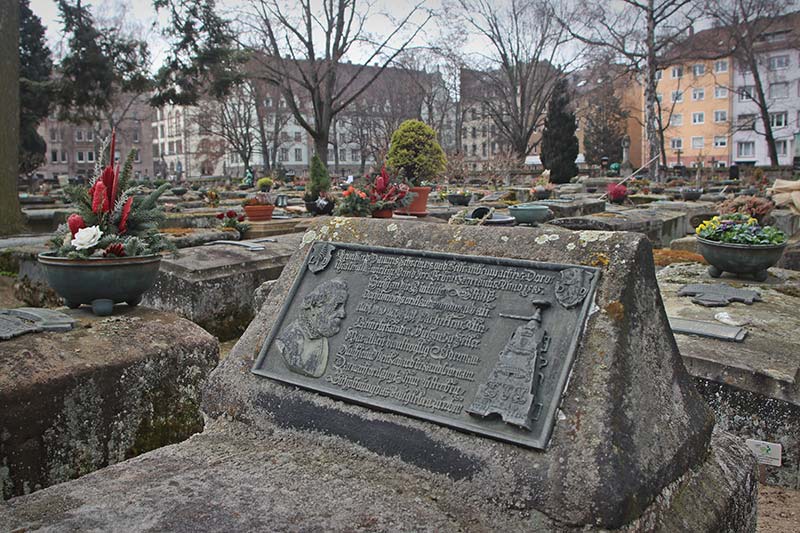
Peter Vischer der Ältere

  • 1455
  • 1529

Peter Vischer the Elder (born around 1455 in Nuremberg; died 7 January 1529 ibidem) was a German sculptor and coppersmith/bronze caster hailing from the Nuremberg Vischer family of metal founders and artists. Numerous epitaphs, including some in Bamberg, Krakow and Lübeck, and the large-format bronze figures depicting Artus and Theoderich at the tomb of Emperor Maximilian I in Innsbruck’s Court Church are testimony of his art. The tomb of St Sebaldus in the east choir of St Sebaldus‘ Church in Nuremberg (1508/19) is considered the major work created in the Vischer workshop and an important example of German Renaissance sculpture.

Grave number: Rochus 90

Johann Pachelbel

  • 1653
  • 03.03.1706

Johann Pachelbel (christened 1 September Julian calendar/ 11 September 1653 Gregorian calendar in Nuremberg; died 3 March 1706 ibidem) was a German organist and composer of the Baroque era. Important life stations included Eisenach, Erfurt, Stuttgart and Gotha, until he came to Nuremberg as organist in St Sebaldus‘ Church. With his fugal chorale settings, he created his very individual, distinctive style. His Canon in D gained particular popularity.

Grave Number: Rochus 308

Salomon Schweigger

  • 30.03.1551
  • 21.06.1622

Salomon Schweigger (born 30 March 1551 in Haigerloch; died 21. June 1622 in Nuremberg) was a Protestant minister and traveller of the Orient. In 1605, he was appointed minister of the Church of Our Lady by Nuremberg Council. In 1608, he published the “New Description of Travel from Germany to Constantinople” which made him famous. In 1616, his translation of the Koran was published in Nuremberg, the very first German-language edition.

Grave Number: Rochus 1341

Elisabeth Krauß

born Streit

  • 29.07.1569
  • 05.04.1639

Elisabeth Krauß, née Streit (born 29 July 1569 in Bronnamberg; died 5 April 1639 in Nuremberg) was a simple maid servant until, in 1598, she married her last employer, Nuremberg merchant Konrad Krauß. She survived him by seven years. With her inheritance she established several foundations which still exist today.

Grave number: Rochus 1274

Friedrich Staedtler

  • 1636
  • 1688

Friedrich Staedtler (born 1636 in Nuremberg; died 1688 ibidem) was a merchant, inventor and the first German pencil maker known by name. Starting in the early 1660s, he manufactured and sold graphite (“black lead white”) pencils with wooden casings – in spite of an explicit prohibition by the Nuremberg council. While in 1661 he had been denied Nuremberg citizenship, the city council granted him citizenship in 1675 in recognition of his economic success. He held the professional title of “lead white founder and pencil maker” until his death.

Grave number: Rochus Neue 181

Friedhöfe St. Johannis und St. Rochus